SpaceX Targets $500 After Q3 Revenue Hits $14.6 Billion
A surge in AI compute demand and Starlink growth drove analysts to sharply raise price targets following a quarter that turned a profit.
By Mykola Bondarenko ·
SpaceX has become the center of Wall Street’s attention after reporting a third-quarter performance that far exceeded expectations, prompting a rapid series of price target increases. Following the release of the earnings report on October 20, 2026, the stock experienced a sharp spike in after-hours and premarket trading. The catalyst for this movement was a significant shift in the company’s financial profile, specifically within its Super Intelligence division, which has emerged as the primary engine of growth.
The path to this moment was paved by aggressive expansion in artificial intelligence infrastructure and satellite connectivity. For much of 2026, the market had focused on the high capital expenditure required to build out these new capabilities. However, the latest figures suggest that the investment phase is beginning to yield substantial returns. The company reported total revenue of $14.6 billion, a 161 percent year-over-year increase that comfortably surpassed the consensus estimate of approximately $12.7 billion. This growth coincided with a net profit of $4.4 billion, a stark improvement from a loss recorded in the same period the previous year, with adjusted EBITDA reaching $8.8 billion.
The Super Intelligence segment, led by CEO Elon Musk and CFO Bret Johnsen, was the standout performer, generating roughly $7.6 billion in revenue. This division grew nearly 830 percent year-over-year, overtaking other business units to become the largest contributor to the top line. Meanwhile, the Connectivity segment, which includes Starlink, delivered $5.2 billion in revenue. Strong subscriber growth pushed the consumer base for Starlink to 13.6 million, while the recent orbital success of the Starship vehicle and the deployment of V3 satellites further solidified the company’s position in the launch and connectivity markets.
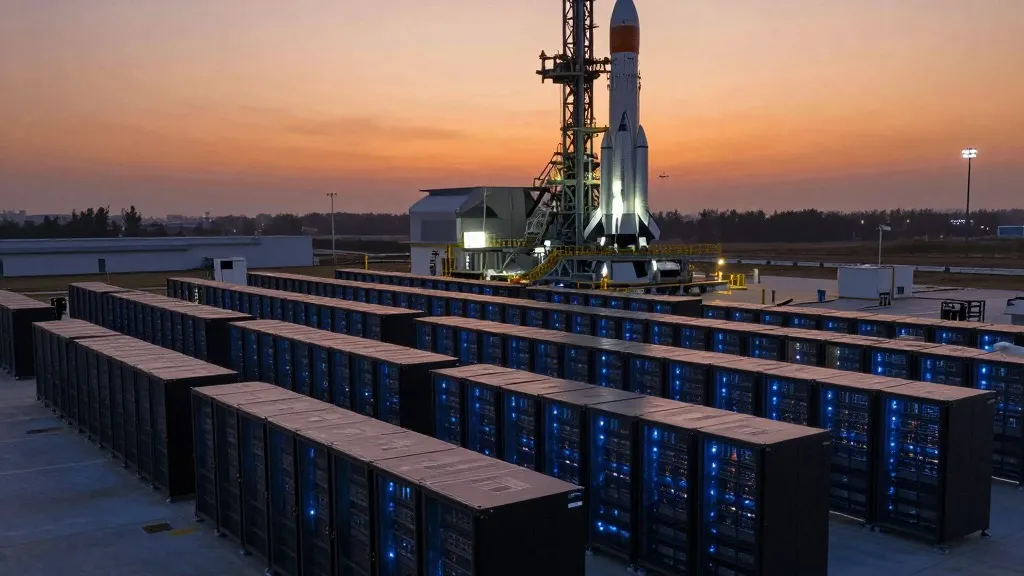
Looking ahead, management outlined a bullish trajectory for the coming year. Guidance for the first quarter of 2027 projects revenue between $33 billion and $37 billion, significantly higher than the roughly $22 billion analysts had previously modeled. To support this growth, SpaceX plans to commit between $35 billion and $40 billion in capital expenditures for the fourth quarter, primarily focused on AI compute infrastructure at sites in Memphis and Southaven. The company aims to reach 2.5 to 3 gigawatts of nameplate compute capacity by the end of this year, with pathways to expand to 13 gigawatts or more by the end of 2027.
Analysts responded to these figures with a wave of optimism, citing the strong quarterly results and accelerating AI demand as key drivers. JPMorgan led the charge, more than doubling its price target to $500 from $240 while maintaining an Overweight rating. Other major firms followed suit, with Cantor Fitzgerald lifting its target to $345, Barclays and Morgan Stanley raising theirs to $300, and Citi increasing its estimate to $240. Wells Fargo and Clear Street also adjusted their targets upward to $274 and $248, respectively. UBS and TD Cowen raised their targets to $230 and $224, respectively, all reflecting a broader consensus that SpaceX’s long-term earnings power is higher than previously thought.
The immediate market reaction was positive, with shares jumping roughly 8 percent in early premarket trading on October 21 after closing at $147.79 the previous day. Investors appear to be weighing the elevated spending plans against the demonstrated ability to monetize new AI compute capacity, which management suggests can support payback periods of less than a year. While the massive capital outlay remains a point of focus, the shift to profitability and the specific milestones achieved in both launch and AI have convinced many analysts that the company’s trajectory is robust across all its major business lines.
As SpaceX continues to expand its footprint, the convergence of its launch, connectivity, and AI operations is creating a unique value proposition for investors. The formation of special committees to explore a potential combination with Tesla adds another layer of strategic interest, though the immediate focus remains on executing the massive compute buildout. With price targets now averaging significantly higher than before the earnings call, the market is signaling a renewed conviction in SpaceX’s ability to sustain its rapid growth in the coming year.
Source: Teslarati